

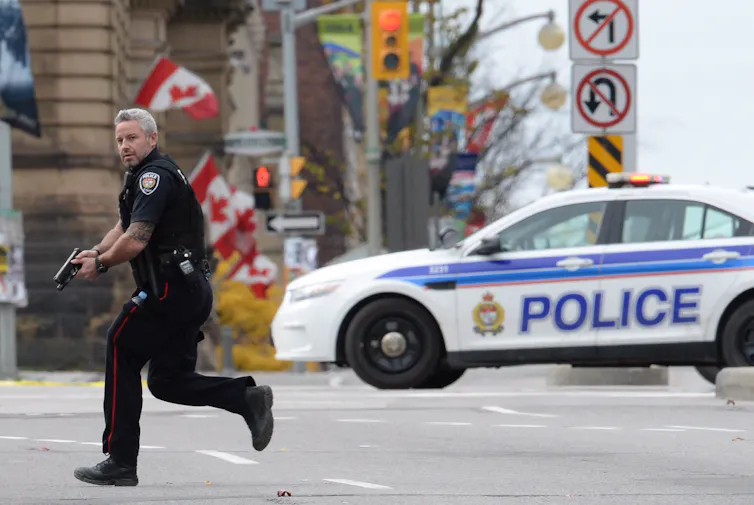
Today is the 11th anniversary of the Parliament Hill shooting, when an Islamist-inspired extremist, Michael Zehaf-Bibeau, stormed Canada’s War Memorial and Parliament Hill, killing one soldier and injuring three other people.
The shooting — the worst attack on Parliament Hill since a failed bomb attempt in 1996 — sent shock waves throughout Canada, as well as internationally. It not only exposed the glaring security vulnerabilities on Parliament Hill but also marked a new reality for Canadians: political violence, long considered a distant threat, had arrived at home.
Eleven years later, many of the lessons Canada should have learned have not yet been put into action. With a marked rise in political polarization and violent attacks, it’s past due for Canada to strengthen its efforts to protect elected officials.
Extremism in Canada
The Canadian Security Intelligence Service (CSIS) classifies three distinct types of extremism: religious, ideological and political. While faith and grievance-based violence continue to make up the lion’s share of incidents in Canada, the threat of politically motivated violent extremism has steadily increased in recent years.
CSIS defines such extremism as “the use of violence to establish new political systems or new structures or norms within existing systems.” This definition, however, is murky in practice, since many attacks target political institutions but are motivated by either an ideological or religious grievance rather than explicit political goals.
In the case of the Parliament Hill shooting, the perpetrator committed the attack in part due to his discontent with Canada’s foreign policy in the Middle East. Though religiously motivated, his actions had political intent.
Likewise, the 2014 shooting in Moncton, N.B. that left three officers killed and two others injured, along with the 2020 vehicle ramming at the gates of the prime minister’s residence in Ottawa, were both committed by far-right extremists. While CSIS correctly classified the attacks as ideologically motivated, they too were, at their core, political.

Regardless of an attacker’s motive — ideological, religious or political — elected officials are increasingly in the line of fire.
According to the Privy Council Office, former prime minister Justin Trudeau and his cabinet faced 337 threats in 2024 alone, up from just three five years earlier.
The same report showed the number of death threats rose from zero in 2019 to 56 in 2022, and 26 in the first half of 2024. When including incidents directed at MPs across party lines, the true scale of the problem is likely much greater.
The global threat
Rising political violence is a global trend. In 2024, more than 2,600 acts of violence targeted local officials across 96 countries, according to the Armed Conflict Location & Event Data Project.
Similarly, Freedom House, a non-profit organization aimed at strengthening democracy and protecting human rights, reported that nearly 40 per cent of countries experienced election-related violence in 2024. Politicians were attacked in at least 20 nations.
The motives behind these attacks were not monolithic; they ranged from a long list of grievances rooted in xenophobia, gender-based hostility, conspiracy theories, anti-authoritarianism, religious extremism and other perceived social or political injustices.
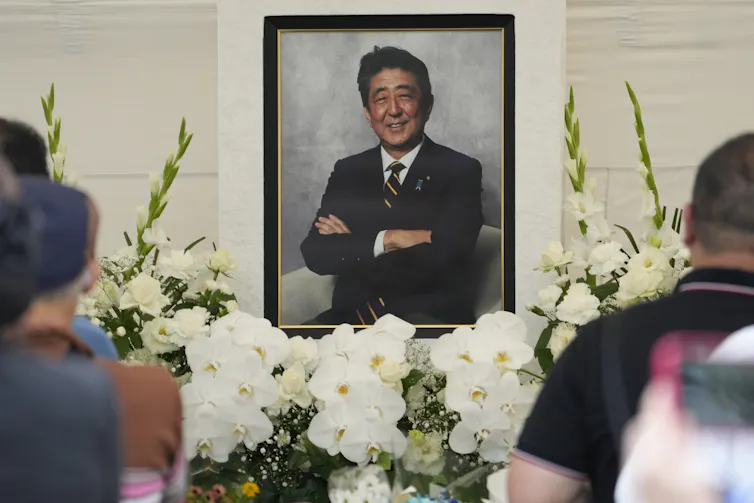
In the past several years, two British MPs, Jo Cox and David Amess, were killed; former Japanese Prime Minister Shinzo Abe was assassinated; South Korean opposition leader Lee Jae-Myung was stabbed; Slovakian President Robert Fico was seriously wounded in a shooting; and former Ukrainian parliament speaker Andriy Parubiy was shot dead.
The United States has been particularly affected by political violence, with at least 300 cases recorded since the Jan. 6, 2021, storming of the U.S. Capitol. According to the Centre for Strategic and International Studies, plots against government targets in the past five years are nearly triple what they’ve been in the past 25 years combined.
The most notable include two failed assassination attempts on U.S. President Donald Trump in 2024, and the killing of Minnesota state representative Melissa Hortman and fatal shooting of right-wing commentator and political activist Charlie Kirk this year.
Read more: How Charlie Kirk became a pioneering MAGA political organizer on campuses
A call to action
The Parliament Hill shooting anniversary reminds us that the threat of political violence has not diminished over the past decade — it’s grown.
Despite the implementation of some security measures — such as combining three disparate security services into the Parliamentary Protective Service, expanding the armed security presence on Parliament Hill and offering the installation of security systems and mobile panic buttons for elected officials — MPs still lack sufficient protection.
Instead of being reactive in the aftermath of any future tragedies, Canada must make proactive investments to safeguard people and institutions likely to be targeted.

That means enhancing screenings before meetings, increasing access to safe rooms, bolstering security at public events, improving emergency response planning and using protective details and physical security judiciously — that is, erring on the side of caution rather than waiting for threats to escalate.
Canada should also strengthen its intelligence and law enforcement communities to counter the evolving threat. This includes:
- Expanding open-source intelligence capabilities to better execute the goals laid out in Canada’s national strategy on countering radicalization to violence;
- Enhancing co-ordination with municipal police forces and hate-crime units;
- Ensuring the legal consequences for political violence and intimidation serve as genuine deterrents;
- And learning best practices from countries like Iceland, Ireland, New Zealand and Australia, which ranked highest on the 2024 Peace Index.
Protecting Canada’s elected officials from political violence is essential, but it must never compromise a fundamental tenet of democracy: the public’s access to their leaders. Striking this balance will likely remain the greatest challenge for decision-makers, and one they simply cannot afford to get wrong.